


Overview of the Case
A series of favorable posts about instructor B at Academy A were published on an online college admissions information community. Believing that the posts had been generated by paid promoters, instructor A instructed teaching assistants to post comments criticizing and disparaging B’s teaching ability and lecture quality.
B filed a criminal complaint against A, alleging online defamation under the Information and Communications Network Act, insult, and obstruction of business.
Our Legal Response:
Defamation
With respect to the alleged violation of the Information and Communications Network Act, our legal team argued that the comments did not constitute the dissemination of false factual statements.
We argued that the comments were not false and, more importantly, did not state specific factual allegations concerning the complainant. Rather, they constituted criticism or expressions of opinion. Accordingly, they did not amount to the publication of false facts required to establish defamation.
Insult
With respect to the allegation of insult, our firm relied on Supreme Court precedent holding that an expression does not constitute the crime of insult if it does not lower the victim’s social evaluation of their personal character, even where the expression may have been somewhat impolite or discourteous.
In particular, the Supreme Court held in its September 10, 2015 decision (2015Do2229) that an expression cannot be deemed to satisfy the elements of insult merely because it was expressed in a somewhat impolite manner, where the expression does not diminish the social evaluation of the other person’s character.
Our legal team argued that the comments at issue were merely expressions of the authors’ opinions or emotions and did not lower the complainant’s social evaluation. Accordingly, the elements of the crime of insult were not satisfied.
Obstruction of Business
With respect to the allegation of obstruction of business, our firm argued that the comments did not constitute obstruction of business by deceptive means.
Under Supreme Court precedent, obstruction of business by deceptive means requires, among other things, that the factual statements at issue be false and that the accused knowingly communicate those false statements.
Our legal team argued that the comments in this case were merely expressions of opinion rather than statements of fact. We further argued that recruiting students was not part of the instructor’s business activities for purposes of the offense. Accordingly, the comments could not be regarded as having obstructed the complainant’s business.
Outcome
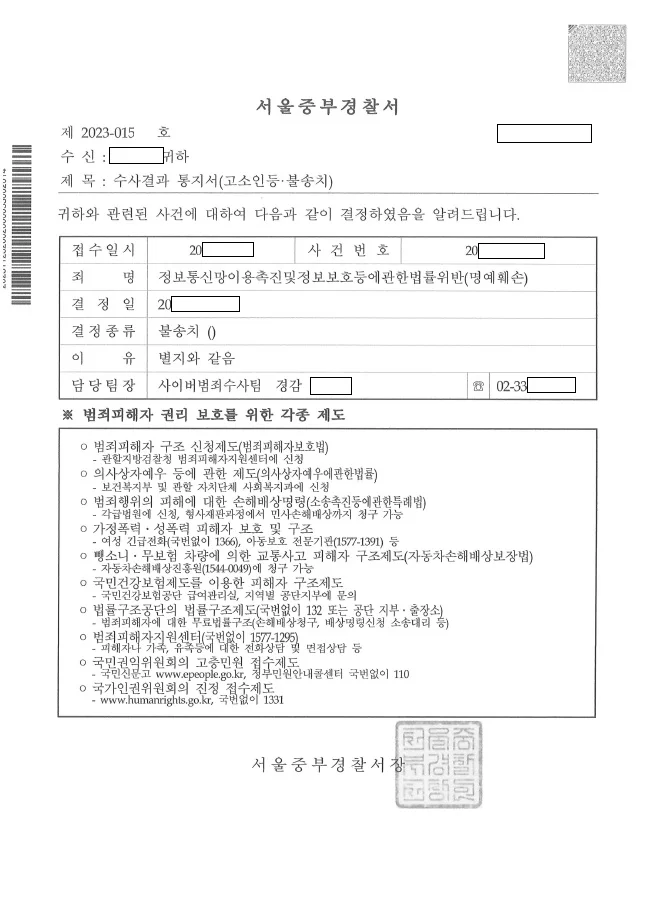
The police accepted our legal arguments and decided not to refer the allegations of defamation and obstruction of business to the prosecution.
The prosecution subsequently determined that there was no criminal offense established with respect to the alleged violation of the Information and Communications Network Act (defamation), and that there was insufficient evidence to establish the alleged offense of obstruction of business.
As a result, the case was ultimately closed without charges.
Attorney: Jae-kwon Jung